

This program focuses on cultivating empathetic FinTech professionals, emphasizing values such as inclusive finance, fair customer treatment, financial accessibility, consumer protection, and sustainable development. It aims to develop versatile talents with cross-disciplinary capabilities who can ultimately contribute to society and the nation.
Using design thinking and agile development methods, this approach integrates cross-domain knowledge in information fundamentals, financial analysis, technology and data, market media, and regulatory frameworks to enable effective communication, collaboration, and innovative synergy.
By emphasizing communication and collaboration, competition-based training, and a learn-and-apply approach, students actively participate in the end-to-end process of creating and implementing financial products and services.
Experts with cross-disciplinary FinTech experience are carefully selected and invited to co-teach, guiding students from a broad practical perspective while incorporating and examining academic theories, ensuring a balanced approach that integrates both theory and practice.
Traditional services like banking, loans, payments, wealth management, and investments can now be accessed via mobile devices, websites, and apps thanks to FinTech.
The purpose of FinTech is to lower financial barriers, increase efficiency, reduce costs, and enhance user experience, making it easier for more individuals and businesses to save, borrow, invest, pay, transfer, manage finances, and insure — no longer exclusive to banks or large institutions.
Moreover, with technological advances (big data, cloud computing, AI, blockchain) and increasing societal demand for financial innovation alongside regulatory oversight, FinTech has evolved into a key trend in modern finance. For young people interested in finance, technology, data analysis, and innovative applications, it is a cross-domain field with broad prospects.
FinTech is the combination of "Finance + Technology" — it reconstructs traditional, complex, and regulated financial services using technology and innovation, making finance more convenient, smarter, and inclusive, and ensuring that financial services are no longer exclusive to large institutions or banks.
This is the very purpose of the “FinTech Applications Department” — to provide interested students the opportunity to learn this interdisciplinary skill set: finance, data, technology, innovation, regulations…
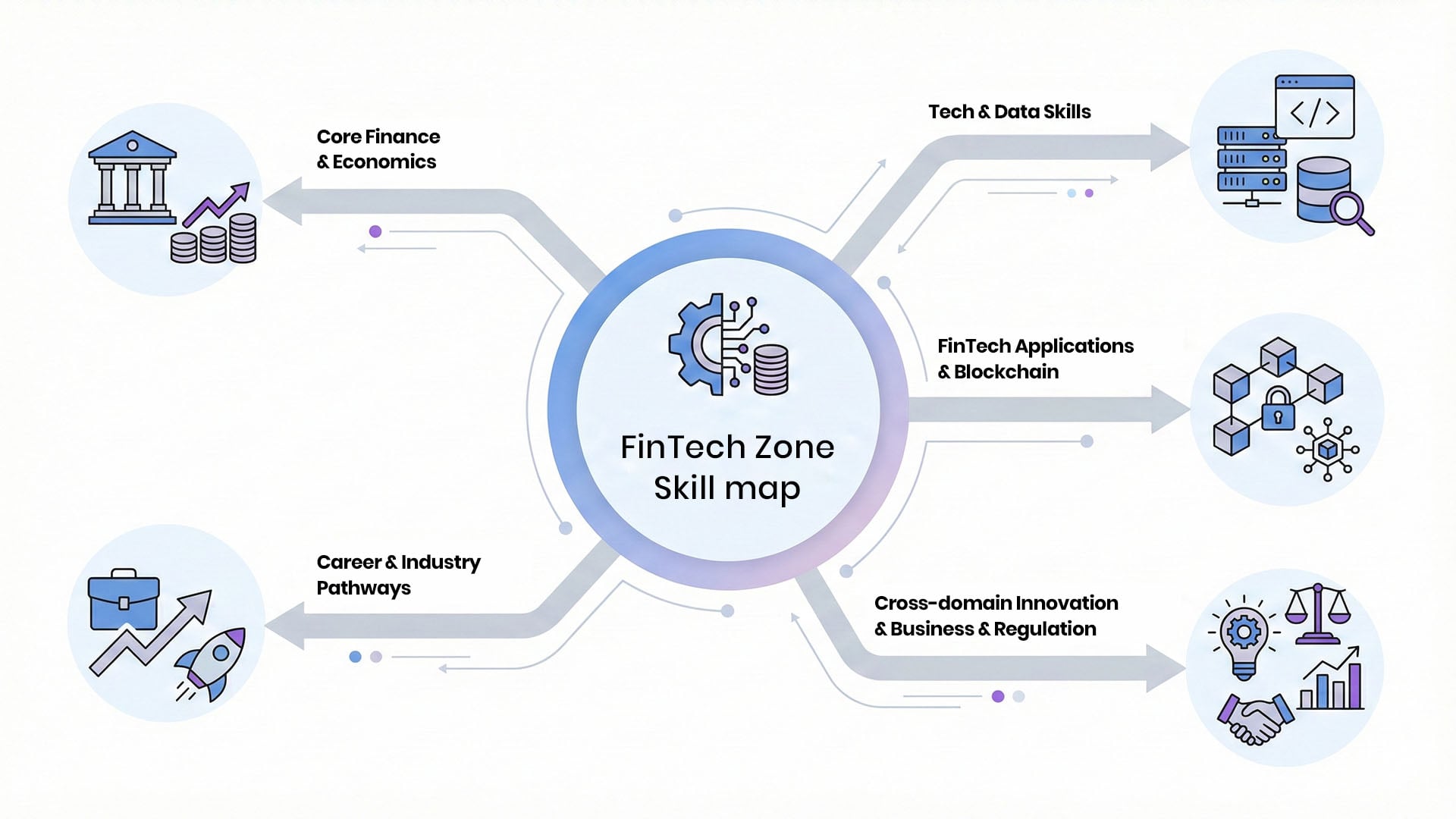
Curious about the skills and capabilities you’ll gain after joining the FinTech program? This page presents our Learning Map, guiding you from foundational finance knowledge and data/technology tools to advanced applications and cross-domain integration. It helps you understand the overall learning path and assess whether this field suits you.
Integrate Learning & Practice, Producing Tangible Outcomes Through Competitions and Workshops
| Academic Year | Principal Investigator | Project Title / Description | Duration |
| 113 ~ 114 | Lin Meng-Hsiang | Defensive and Base-running Player Movement Tracking Analysis in Chinese Professional Baseball League | 113/11/01 ~ 114/10/31 |
| 113 ~ 114 | Luo Wen-Chi | Time Series Return and Structural Change Detection of Abnormal Investment Phenomena | 113/08/01 ~ 114/07/31 |
| 112 ~ 113 | Lin Meng-Hsiang | Regulatory Boundaries and Legal Framework for Virtual Assets: Consumer Protection as Core | 112/08/01 ~ 114/07/31 |
| 112 ~ 113 | Jiang Dai-Lun | Applying Dynamic Secure Access Mechanisms to Cloud-based Digital Learning Platforms | 112/08/01 ~ 113/07/31 |
| 111 ~ 112 | Jiang Dai-Lun | Lifestyle and Medical Data Assisted Suicide Prevention Decision Support System | 111/08/01 ~ 112/07/31 |
| 109 ~ 110 | Huang Yan-Bin | Predicting User Behavior in FinTech Chatbot Usage | 110/01/01 ~ 110/12/31 |
| Academic Year | Student Name | Advisor | Project Title / Description |
| 113 | Chen Zi-Yu | Luo Wen-Chi | Study on Carbon Emission Management and the Impact of Carbon Tax on Bank Lending |
| 112 | Chen Pei-Ying | Luo Wen-Chi | Performance of ESG-labeled Mutual Funds and Fund Managers’ Stock Picking & Timing Abilities |
| 111 | Zhan Fang-Xuan | Lin Meng-Hsiang | Implementing Stable Trading Patterns in High-Volatility Crypto Markets – A Case Study on Pionex |
| 111 | Gao Zhen-Yi | Luo Wen-Chi | Impact of Corporate Social Responsibility on Shipping Supply Chain Risks – Evidence from the Ever Given Incident |
| 110 | Zhuang Ya-Han | Jiang Dai-Lun | Guided by Experts: Finding Your Path in the FinTech Career Learning Map |
| 109 | Lin Jia-Yi | Lin Meng-Hsiang | AML in Pure Digital Banks Applied to Blockchain |
| Academic Year | Principal Investigator | Project Title | Research Topic | Duration |
| 111 | Lin Meng-Hsiang | Teaching Practice Research Project | Construction of Inclusive Finance Credit Model and Blockchain Applications | 111.08.01 – 112.07.31 |
| 110 | Huang Yan-Bin | Teaching Practice Research Project | Can Problem-Based Learning Effectively Enhance University Students’ Perception of Social Responsibility? | 110.08.01 – 111.07.31 |
Collaborating with industry to provide a bridge for internships and employment
Through our curriculum + cross-domain skills training, you will gain the ability to integrate finance, technology, data, regulations, and innovation, opening up multiple career possibilities for you.
FinTech is not just a trend or a buzzword — it is an industry that is reshaping the global financial ecosystem, offering a diverse and promising career path.
We encourage individuals aspiring to enter FinTech to participate.
Since the "FinTech Zone" content originates from the Department of FinTech Applications and its affiliated units, the contact points should be the corresponding department and master's program:
If you are interested in the department, the following content will help you quickly understand the learning directions and key features of the program:
Ming Chuan University offers FinTech programs in Taoyuan and Taipei, training students in finance and technology. Courses cover sustainability, data analysis, and tech law, building cross-domain skills and enhancing graduate competitiveness.